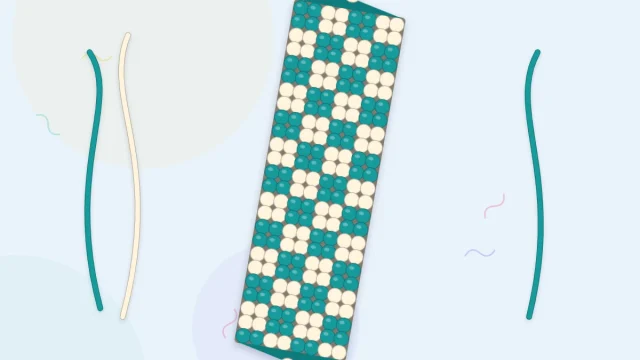
Alpha Heart Bracelet Pattern: A Small Heart, Row by Row
An original small heart motif for an alpha bracelet on nine base strings, written out row by row, with advice on switching between the heart and background colors and keeping the outline sharp.

Tutorial at a glance
Materials
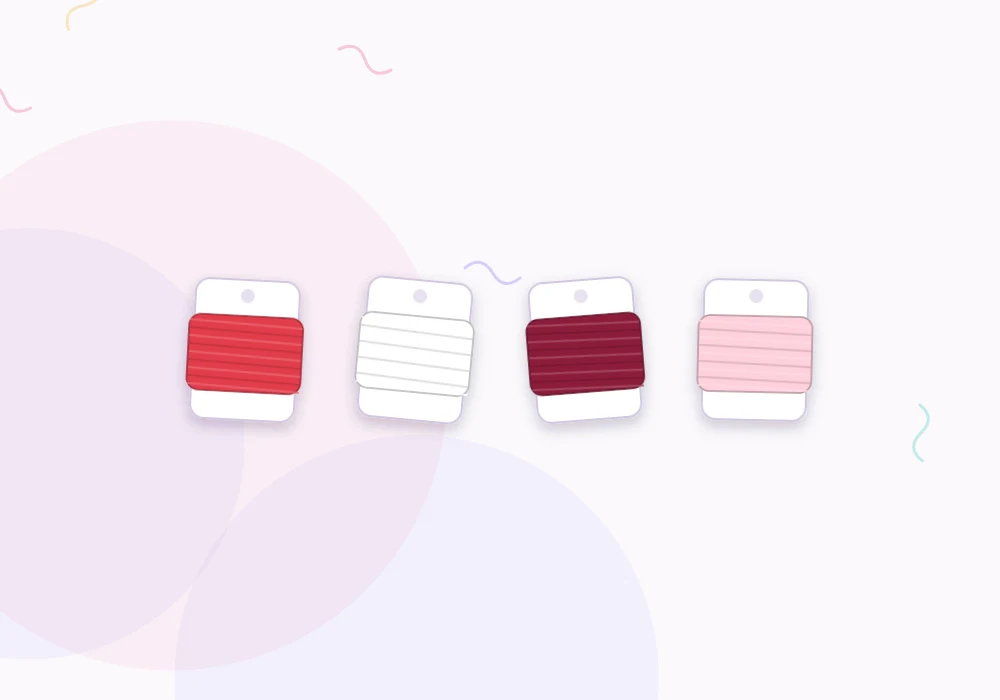
- Embroidery floss in red and white
- Scissors
- Tape or a clipboard
- A pin for undoing knots
- Bobbins or card for winding long strings
A heart is the classic first picture to knot, and this alpha heart bracelet pattern keeps it small enough to finish in one sitting: a red heart seven knots wide on a white background, repeated down the strip. The grid is an original design, written out below row by row, with notes on where the two colors trade places and how to keep the outline sharp.
The project assumes you can already knot plain horizontal rows. If base strings and working strings are new terms, start with alpha bracelet patterns for beginners and come back.
Strings and supplies
- 9 base strings in white, each about 30 in (76 cm).
- 1 background working string in white, about 130 in (330 cm).
- 1 heart working string in red, about 90 in (229 cm).
- Scissors, tape or a clipboard, a pin, and two bobbins or pieces of card for winding the long strings.
All floss is used whole, with all six strands. The working lengths are estimates for a wrist-length strip; the white string ties more knots than the red one, so it is cut longer.
Tie all eleven strings together in an overhand knot about 4 in (10 cm) from the top, anchor the knot, spread the nine base strings flat, and bring both working strings out at the left edge.
The heart grid
The design repeats every eight rows: two plain rows that separate one heart from the next, then six rows of heart. Columns are numbered 1 to 9 from left to right, one per base string. In the table, R is a red knot and W is a white knot.
| Row | Direction | Knot | Columns 1 to 9 |
|---|---|---|---|
| 1 | Left to right | Forward | W W W W W W W W W |
| 2 | Right to left | Backward | W W W W W W W W W |
| 3 | Left to right | Forward | W W R R W R R W W |
| 4 | Right to left | Backward | W R R R R R R R W |
| 5 | Left to right | Forward | W R R R R R R R W |
| 6 | Right to left | Backward | W W R R R R R W W |
| 7 | Left to right | Forward | W W W R R R W W W |
| 8 | Right to left | Backward | W W W W R W W W W |
The heart is symmetrical, so every row reads the same from either end.

Switching colors inside a row
Both working strings cross every row together, including the plain white rows. Whichever string is not tying the current knot is laid along the base string and knotted over, so it stays hidden and is in position when its color comes up. The alpha checkerboard bracelet pattern explains that carrying method in detail and is a good warm-up if it is unfamiliar.
Three spots in the heart need extra care:
- The notch (row 3, column 5). A single white knot sits between two pairs of red. Switch to white for one knot and straight back to red, pulling the red string snug before it takes over again.
- The point (row 8, column 5). A single red knot between long runs of white. The red string has been resting for four knots, so take up its slack before you tie with it.
- The wide rows (rows 4 and 5). Only the two edge knots are white. Make sure the white string turns the corner with the red one at the end of row 4.
Tip
After each color switch, tighten the first half hitch of the new color firmly and the second one a little more gently. The first half hitch sets the position of the knot; over-pulling the second can twist it and show a fleck of the other color.
Knotting the heart, row by row
- Row 1. Left to right, nine white forward knots, with the red string carried inside each one.
- Row 2. Right to left, nine white backward knots, starting on base string 9.
- Row 3, the two bumps. Left to right: two white knots on base strings 1 and 2, two red on 3 and 4, one white on 5, two red on 6 and 7, two white on 8 and 9.
- Row 4. Right to left, starting on base string 9: one white knot, seven red knots on base strings 8 down to 2, one white knot on base string 1.
- Row 5. Left to right: one white, seven red, one white. The heart is now at its full width for a second row.
- Row 6. Right to left: two white on base strings 9 and 8, five red on 7 down to 3, two white on 2 and 1.
- Row 7. Left to right: three white, three red on base strings 4, 5 and 6, three white.
- Row 8, the point. Right to left: four white on base strings 9 down to 6, one red on base string 5, four white on 4 down to 1.
Return to row 1 and repeat. Because the repeat has an even number of rows, every heart starts with the strings at the left edge and the directions never change. Eight rows cover roughly 3/4 to 1 in (2-2.5 cm) depending on your tension, so a wrist-length strip holds about six or seven hearts. Allow about 3-4 hours for a first bracelet.
Watch out
The heart is knotted from its top to its point, so it stands upright along the length of the strip. On the wrist the hearts lie sideways, pointing around the band. That is normal for a narrow alpha strip.
Keeping the outline crisp
- Count before the switch, not after. Touch the base string you are about to knot and say its number. Most heart mistakes are a switch made one column early or late.
- Check each row against the one above. From row 5 on, the red section loses one knot at each side per row. If it shrinks on one side only, the row is off by one.
- Fix it right away. A wrong-color knot is easy to pick out with a pin while it is the last one tied, and much slower two rows later. See how to fix friendship bracelet mistakes for unpicking and for joining a new string if a working string runs short.
Color and spacing variations
The grid works with any two colors that contrast strongly. A burgundy heart on blush gives a softer look than red on white, and reversing the colors, with a white heart on red, makes the shape stand out from across a room. Low-contrast pairs such as lilac on blush tend to blur the notch and the point.
To spread the hearts out, knot four plain rows between them instead of two. Keep the number of plain rows even so each heart still begins at the left edge.

Frequently asked questions
How many strings does an alpha heart bracelet need?
This pattern uses eleven: nine base strings that set the width, one white working string for the background and one red working string for the heart.
Is the heart pattern suitable for a first alpha bracelet?
It works best as a second or third alpha project. Knot a plain strip first, then practice color changes, because the heart has a different color layout in almost every row.
Why does my heart look stretched?
Rows that are not pushed up tightly make the motif taller than the grid. Tighten each half hitch and nudge every finished row against the one above.
Can the heart be made wider or narrower?
The motif itself is seven knots wide, so it needs at least seven base strings. Add base strings in pairs, one on each side, for a wider background border.