The Best Thread for Friendship Bracelets: Floss, Pearl Cotton or Craft Thread
Six-strand cotton embroidery floss is the standard thread for friendship bracelets. See how it compares with pearl cotton and craft thread for strands, sheen, colorfastness and price before you buy.
The best thread for friendship bracelets is plain 6-strand cotton embroidery floss, used whole. It is inexpensive, comes in hundreds of colors, grips itself well enough to hold a knot, and is forgiving when a knot has to come back out. Pearl cotton and craft thread also work, and each one changes how the finished bracelet looks and feels. This guide compares the three so you can buy with a plan instead of grabbing whatever is on the shelf.
Why embroidery floss is the standard
A friendship bracelet is hundreds of small knots sitting side by side, so the thread has to do three jobs at once: slide smoothly while a knot is being pulled up, stay put once it is tight, and show a clear, solid color. Cotton embroidery floss does all three. Its six loosely twisted strands flatten slightly under tension, which lets each knot spread out and cover the string underneath.
A standard skein holds about 8.7 yd (8 m). At 32 in (81 cm) per string, that is roughly nine strings from one skein, enough for one color in several bracelets.
Embroidery floss vs. pearl cotton vs. craft thread
| Thread | Structure | Look | Best for | Drawback |
|---|---|---|---|---|
| 6-strand embroidery floss | Six fine strands, lightly twisted together, can be separated | Soft sheen, full flat knots | Every pattern, especially first projects | Can fuzz or split if knots are picked out many times |
| Pearl cotton | One firmly twisted cord that does not separate | Brighter sheen, round, beaded-looking knots | Crisp chevrons and detailed alpha designs | Fewer colors in most stores, slightly stiffer to knot |
| Craft thread | Usually a single twisted cord, often a cotton blend | Matte, casual | Practice, group projects, large batches | Thickness and dye quality vary from pack to pack |

Strands: use all six
Embroidery floss is designed to be divided for needlework, which leads many beginners to wonder whether it should be split for bracelets too. It should not. Use each cut length whole, with all six strands together, and treat it as one string. Whole floss gives a knot about the width of a small seed bead, and a bracelet of eight strings ends up close to 3/8 in (1 cm) wide.
Splitting the floss into three strands produces a very fine, delicate bracelet, but the knots are tiny, slow to tie and hard to unpick. Save that experiment for later. Doubling the floss (twelve strands per string) makes a chunky band that eats string quickly, so add extra length if you try it. The usual cutting lengths are covered in the guide on how to measure friendship bracelet string.
Pearl cotton is sold by size number, and a lower number means a thicker cord. Size 5 is the closest match to whole 6-strand floss, so the two can share a bracelet. Size 8 is noticeably finer and makes a narrower band.
Tip
Keep one bracelet in one type of thread until you know how each behaves. Mixing a thick string with a thin one makes rows slant unevenly, because the thick knots take up more room than their neighbors.
Sheen and texture
Most cotton floss and pearl cotton is mercerized, a finishing process that makes the fibers smoother, stronger and better at taking dye. That is where the soft shine comes from. Matte cotton and many craft threads skip the high-gloss finish, so their colors read flatter and a little chalkier.
- Glossy cotton makes colors look saturated and helps stripes stand apart from each other.
- Matte thread has more grip, so knots hold tightly but also resist sliding into place. Pull each half hitch up firmly.
- Metallic and satin (rayon) floss looks striking and is slippery, springy and prone to fraying. Use it as a single accent string beside cotton, not for a whole first bracelet.
- Variegated floss changes shade along its length. It creates soft color shifts with no planning, although it blurs sharp patterns such as chevrons.
Colorfastness and wear
Friendship bracelets are traditionally worn until they fall off, which means showers, pools, sunscreen and sun. Good cotton floss is dyed to be colorfast, and many labels say so. Bargain packs are less predictable, and deep reds, navy and black are the shades most likely to bleed onto a white or pale neighbor.
A quick test before you commit a doubtful color to a bracelet with white in it:
- Cut a short piece, about 3 in (8 cm).
- Soak it in warm water with a drop of soap for a few minutes.
- Press it between two layers of white paper towel and let it sit until nearly dry.
- Check the towel. Any tint means the color may bleed, so pair it with dark colors or rinse the thread until the water runs clear and let it dry before knotting.
Watch out
Chlorine and strong sun fade every dye over time, colorfast or not. Pale pastels and neon shades show it first. If a bracelet is meant to last a whole summer outdoors, choose medium and dark colors for the widest stripes.
What to buy for a first project
A small, deliberate purchase beats a huge assortment of thread you cannot identify later. For a first bracelet, pick up:
- Four to six skeins of 6-strand cotton floss in colors that contrast clearly: for example one dark, one light and two brights.
- One skein of white or cream. A neutral separates bright stripes and makes almost any combination look tidier.
- Sharp scissors and tape or a clipboard to hold the work.
Contrast matters more than the exact shades. Two similar blues side by side will hide your knots, which makes it harder to see mistakes while you are learning. With supplies in hand, the orientation in friendship bracelets for beginners explains setup, and the candy stripe bracelet is the usual first pattern.
Storing and handling thread
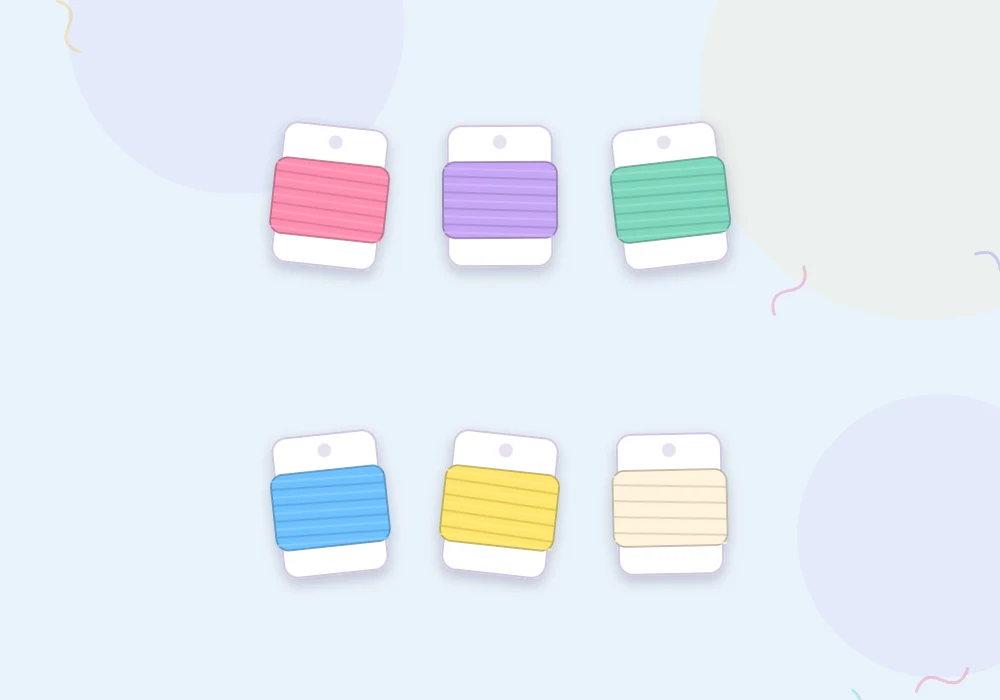
Skeins tangle once the paper bands slide off. Winding each color onto a flat card bobbin takes a few minutes and saves far more time later. Write the color number from the band on the bobbin so you can buy the same shade again. Store thread away from direct sun, and keep cut strings from a project in progress together in a small bag so a missing color does not stall the bracelet halfway.
When you cut, pull the floss from the skein slowly by the loose end nearest the longer paper band. If it snags, stop and ease the loops apart instead of tugging, because a hard pull tightens the tangle.
Frequently asked questions
Do you split embroidery floss for friendship bracelets?
No. Use each cut length whole, with all six strands together, as one string. Splitting the floss makes very small knots that are slow to tie and hard to undo.
Can you mix pearl cotton and embroidery floss in one bracelet?
Yes, if the thicknesses match. Size 5 pearl cotton is close to whole 6-strand floss, so the knots come out a similar size. Finer sizes make uneven rows next to floss.
How many bracelets does one skein of floss make?
A standard skein holds about 8.7 yd (8 m), which gives roughly nine strings of 32 in (81 cm). That is enough for one color in about four bracelets that use two strings of that color each.
Will friendship bracelet thread bleed in water?
Good cotton floss is dyed to be colorfast, but cheap packs and deep reds, navy and black can bleed. Soak a short piece and press it on white paper towel to test before pairing it with white.


