How to Measure Friendship Bracelet String: Lengths for Every Pattern
Find out how long to cut friendship bracelet string for each pattern type, with a table of lengths and simple adjustments for wrist size, loop starts and long working strings.

Tutorial at a glance
Materials
- Embroidery floss
- Ruler or tape measure
- Scissors
Cut too short and the bracelet stops an inch before it reaches around your wrist. Cut too long and you spend the whole project untangling. Knowing how to measure friendship bracelet string comes down to three things: the pattern type, the size of the wrist, and how you plan to start. For a standard knotted bracelet the rule of thumb is about 30-36 in (76-91 cm) per string, and the sections below explain when to move away from that number.
Why bracelets use so much string
Every knot is two half hitches wrapped around a neighboring string. The string doing the wrapping, the working string, gets used up; the string being wrapped stays almost straight. A knotted bracelet 6 in (15 cm) long can therefore consume four or five times that length of thread.
In diagonal patterns such as the candy stripe and chevron, every string takes a turn as the working string, so all of them shorten at about the same rate and can be cut to the same length. In patterns where one string does most of the knotting, that string needs far more than the rest.
String length by pattern type
These lengths suit an average adult or teen wrist and leave enough at each end for ties. The folded column applies when a string is doubled over to make a loop at the top, which turns one cut piece into two working strings.
| Pattern type | Cut length per string (tied start) | Cut length if folded in half |
|---|---|---|
| Candy stripe or diagonal stripe, 6-8 strings | 30-36 in (76-91 cm) | 60-72 in (152-183 cm) |
| Chevron or zigzag, 8 strings | 32-36 in (81-91 cm) | 64-72 in (163-183 cm) |
| Wide chevron or diamond, 10-12 strings | 38-42 in (97-107 cm) | 76-84 in (193-213 cm) |
| Simple braid, no knots | 16-20 in (41-51 cm) | 32-40 in (81-102 cm) |
| Base strings for horizontal stripes or alpha | 20-24 in (51-61 cm) | 40-48 in (102-122 cm) |
| Working string for horizontal stripes or alpha | 80-120 in (203-305 cm) | Not folded |
Wider bracelets need longer strings because each string crosses more neighbors, and ties more knots, before its row is finished. That is why a wide chevron bracelet gets several extra inches per string.
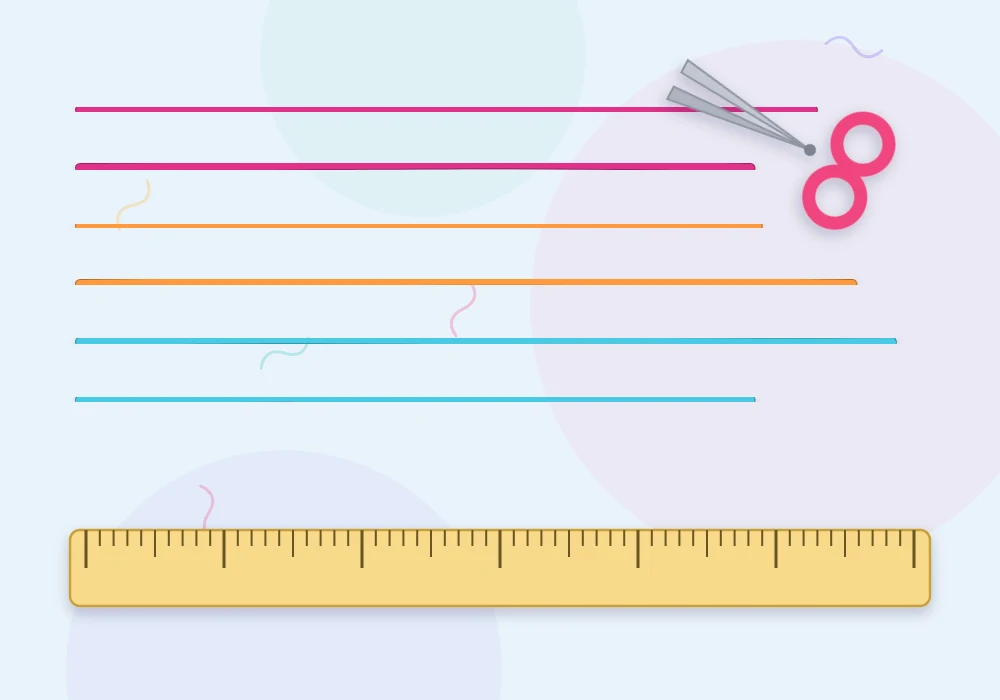
The long working string in stripes and alpha patterns
A horizontal-stripe bracelet and an alpha bracelet are built differently from diagonal patterns. One working string travels back and forth across fixed base strings and ties every knot in the row. The base strings only need to be a little longer than the finished bracelet plus its ties, while the working string does all the work.
Estimate it this way: allow roughly 1 in (2.5 cm) of working string for every knot it ties, then add 8 in (20 cm) for handling. A row across 8 base strings uses about 8 in (20 cm), so ten rows of one color need about 80 in (203 cm). When several colors share the knotting, as in the designs covered in alpha bracelet patterns for beginners, each color needs only its share of the rows.
Tip
A very long working string tangles less if you wind most of it into a small bundle and hold it with a clip or a loose slip knot. Let out more as you go.
Adjusting for wrist size
Measure the wrist snugly with a tape measure or a strip of paper. The knotted section should be about the same as that measurement, or up to 1/2 in (1.3 cm) shorter if the bracelet closes with ties, because the ties bridge the gap.
- Child’s wrist, about 5-5.5 in (13-14 cm): subtract 4 in (10 cm) from the table lengths.
- Average wrist, about 6-7 in (15-18 cm): use the table as written.
- Large wrist or anklet, 8-10 in (20-25 cm): add 8-12 in (20-30 cm) per string.
As a rough conversion, each additional inch (2.5 cm) of knotted bracelet costs about 4-5 in (10-13 cm) of every string in a diagonal pattern.
Adjusting for the start method
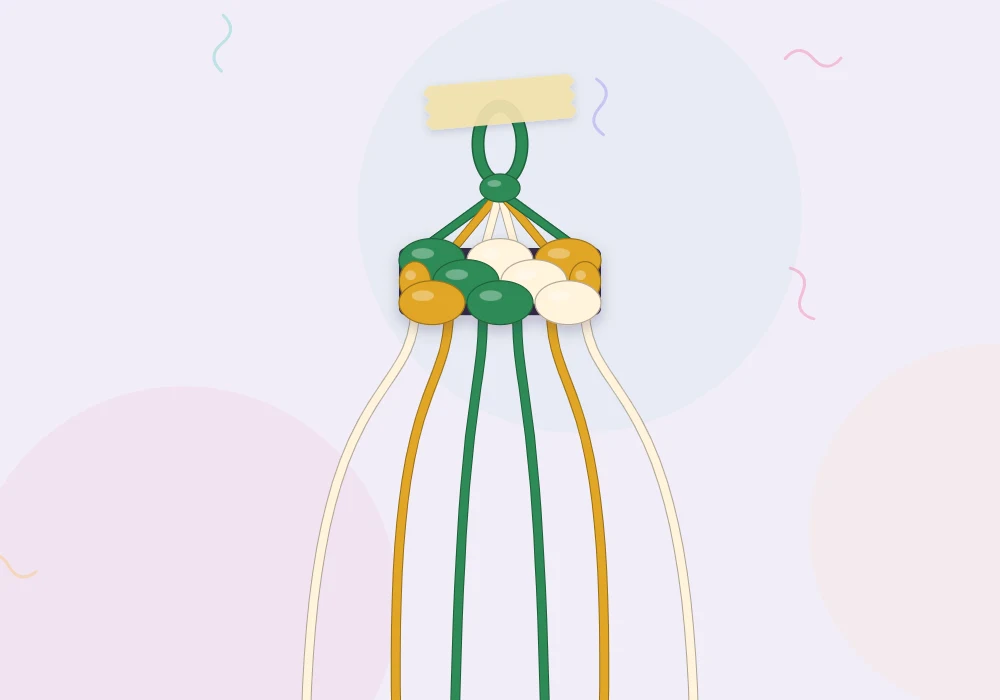
The way the bracelet begins changes how you cut. With a tied start, every string is cut separately and a few inches above the top knot are left free for ties. With a loop start, half as many pieces are cut at double length, folded at the middle, and knotted just below the fold. The different options are compared in how to start a friendship bracelet.
Two details are easy to miss:
- A folded string gives two strings of the same color. That suits a chevron, where each color appears twice, and does not suit a pattern that needs an odd number of one color.
- A braided loop uses up a little of the middle of each string, so add about 2 in (5 cm) to the doubled length.
Measuring without a ruler
Body measurements are good enough for most bracelets. For many adults, the distance from fingertips to the opposite shoulder with the arm stretched out sideways is close to 30-36 in (76-91 cm), which is one standard string. Twice that span is a folded string. Check your own span against a tape measure once and you will know how much to add or subtract.
After cutting the first string, lay the others beside it and cut them to match instead of measuring each one. Hold the ends level so the strings do not creep out of line.
Watch out
Tight knotters use more string than loose knotters, and thicker thread uses more than fine thread. On a first try of any pattern, add 4-6 in (10-15 cm) of insurance. Trimming a long tail takes seconds; running out near the end means joining in a new string.
What to do with the leftovers
Note how much string was left over when a bracelet is finished. If every string has more than 6 in (15 cm) spare beyond the ties, cut that pattern a little shorter next time. Keeping a small card with the pattern name, string count, cut length and leftover amount turns guesswork into your own reliable chart after three or four bracelets.
Frequently asked questions
How long should string be for a friendship bracelet?
About 30-36 in (76-91 cm) per string for a standard wrist bracelet with a tied start. Double that to 60-72 in (152-183 cm) when a string is folded in half for a loop start.
Why does the working string in an alpha bracelet need to be so long?
It ties every knot in every row while the base strings stay straight. Allow roughly 1 in (2.5 cm) per knot, which often adds up to 80-120 in (203-305 cm).
How do I measure string without a ruler?
Stretch one arm out sideways and measure from your fingertips to the opposite shoulder. For many adults that span is close to one standard string, and twice the span is a folded string.
What if I cut my strings too short?
You can join in a new string on the back of the bracelet, or finish with longer braided ties to make up the missing length. Adding a few spare inches on a first try avoids both.


