Wide Chevron Bracelet With 10 or 12 Strings
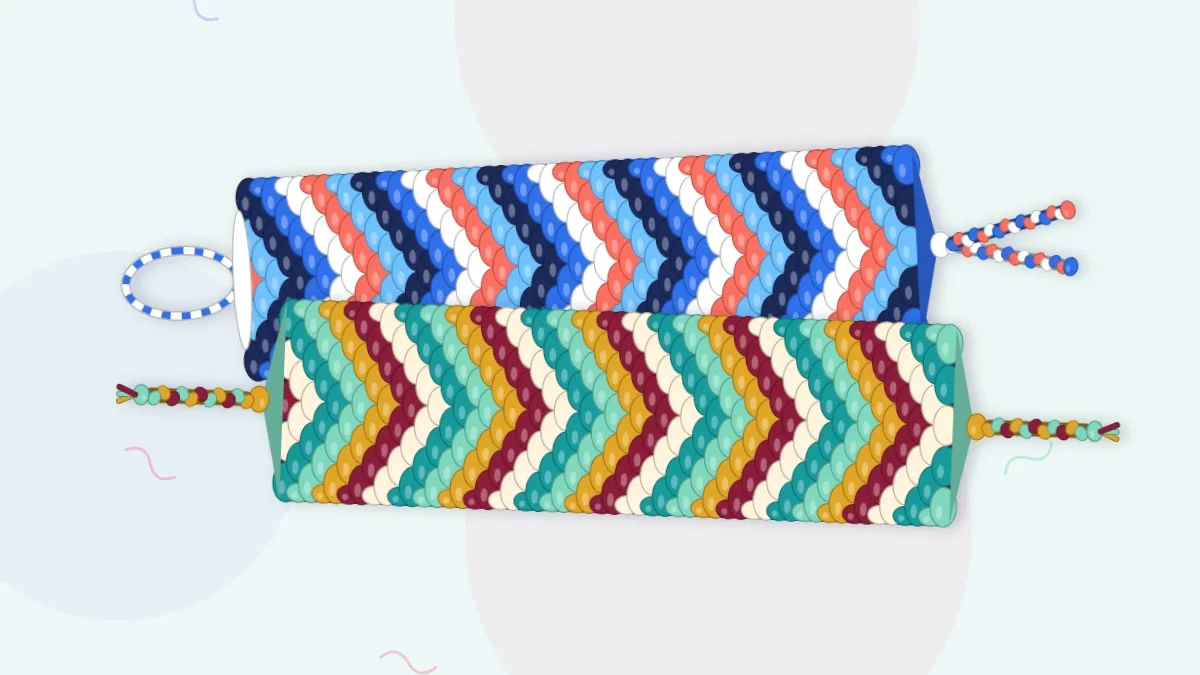
A wide chevron bracelet uses 10 or 12 strings for a bolder band. Here is how much floss to cut, how to keep that many strings in order, and how to hold a sharp V.
Tutorial at a glance
Materials
- Embroidery floss in 5 or 6 colors
- Scissors
- Ruler or tape measure
- Clipboard or safety pin
- Cardboard with slits or small clips to hold strings
Adding strings is the simplest way to turn a familiar pattern into something bolder. A wide chevron bracelet uses 10 or 12 strings instead of the usual eight, which gives a band roughly as wide as a finger and room for five or six colors in every V. No new knots are involved. What changes is the housekeeping: longer strings, more of them to keep in order, and a longer diagonal that shows every bit of uneven tension.
What changes when a chevron gets wider
The row itself is identical to the one in the classic chevron tutorial: the left outer string ties forward knots to the middle, the right outer string ties backward knots to the middle, and the two meet in one center knot. With more strings, each half simply has more knots in it.
| Strings | Colors | Knots per row | Approximate width | Suggested length per string |
|---|---|---|---|---|
| 8 | 4 | 7 | 3/8 in (1 cm) | 36 in (91 cm) |
| 10 | 5 | 9 | 1/2 in (1.3 cm) | 40 in (102 cm) |
| 12 | 6 | 11 | 5/8 in (1.6 cm) | 44 in (112 cm) |
Widths are estimates for whole 6-strand floss and firm knots. Looser knotting or thicker thread gives a wider band. The V also becomes deeper: with 12 strings the point sits noticeably lower than the edges, so one color band takes up more of the bracelet’s length.
How much string a wide chevron needs
In a chevron, every string spends its time traveling diagonally from an edge to the middle and back out again. The wider the band, the longer that sideways trip, so each string is used up faster for the same finished length. The working pair also ties more knots per row, and knots are what consume floss.
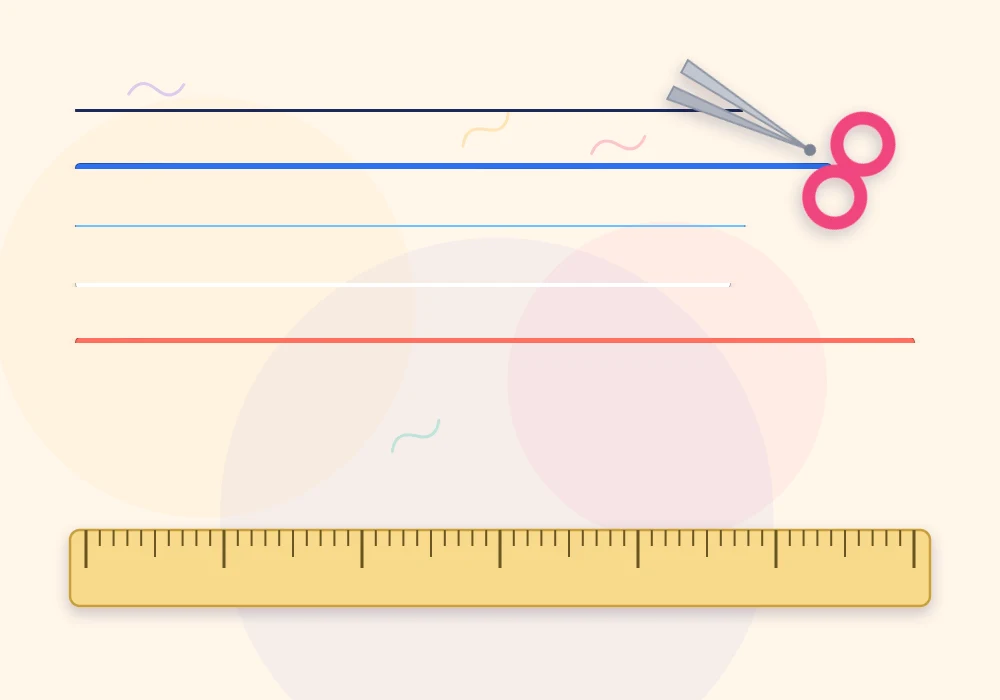
That is why the usual 30 to 36 in (76 to 91 cm) rule of thumb runs short here. For a wrist-length bracelet with tied ends, cut about 40 in (102 cm) per string for 10 strings and about 44 in (112 cm) for 12. With a folded loop start, double those figures to 80 in (203 cm) and 88 in (224 cm). The guide on how to measure friendship bracelet string covers adjustments for larger wrists and anklets.
Tip
Leftover floss can be trimmed, but a string that runs out cannot be stretched. When in doubt between two lengths, cut the longer one.
Setting up 10 or 12 strings
The example here uses 10 strings in five colors, arranged in mirrored order from left to right: navy, cobalt, sky, white, coral, coral, white, sky, cobalt, navy. The pair in the middle is the last color to be knotted, so put a color there that you want as an accent rather than an opener. For 12 strings, add a sixth color to the mirrored order in the same way.
A wide bundle needs a firm anchor. A single piece of tape tends to peel under the pull of 10 strings, so a clipboard or a safety pin through the starting knot is a better choice. The comparison in how to start a friendship bracelet shows the options. Whichever you choose, spread the strings flat below the anchor so they lie side by side instead of in a rope.
Managing many strings
Most of the frustration with a wide chevron comes from tangles and lost order, not from the knotting. A few routines keep things calm:
- Work in two groups. After every center knot, part the strings into a left five and a right five. You only ever handle one group at a time.
- Park the strings in order. Cut ten short slits along the bottom edge of a piece of cardboard and rest each string in its own slit between rows. On a clipboard, a second clip near the bottom does a similar job.
- Shorten the tails. Strings of 40 in (102 cm) or more tangle around each other. Wind the lower part of each one into a loose figure-eight bundle and secure it with a small clip or a slip knot, letting out more as needed.
- Untwist as you go. Knotting adds twist to the working string. Let it dangle and spin free every few rows so it does not kink.
- Say the row out loud. “Four forward, four backward, center” for 10 strings; “five, five, center” for 12. A missed knot is much easier to catch at the time than three rows later.

Keeping the V sharp
On a narrow bracelet, small differences in tension hide between the knots. On a wide one, the long diagonal makes them visible as a bowed line, a flattened point or a wavy edge. These checks help:
- Start each half with a firm edge knot. The first knot of each half sets the height of the whole row. Pull it up until it touches the row above.
- Aim each knot at the point. As you tighten, pull the working string up and slightly toward the center, so each knot lands a little lower than the one before it.
- Keep the knotted-over string straight. Hold it taut and pointing straight down. If it leans, the knot rolls sideways and the line bends.
- Snug the center knot. A loose center knot rounds off the tip of the V. Tighten both half hitches fully.
- Compare the two arms. After each row, look at whether the left and right diagonals mirror each other. Correct on the next row by easing or firming one hand.
Watch out
Pulling the edge knots much tighter than the rest draws the sides in and makes the band cup or curl. Aim for the same firm pull on all nine or eleven knots in the row.

If a row has already gone wrong, it is worth undoing it while it is still the most recent one. The steps for picking knots out with a pin are in the guide to fixing friendship bracelet mistakes.
Time, length and finishing
A wide chevron takes longer than a narrow one in two ways: there are more knots in every row, and each row adds less finished length than you might expect because the V is so deep. Plan on about 3 to 4 hours for 10 strings and 4 to 5 hours for 12 on a first attempt, spread over several sittings if you like.
Measure progress along the edge, not at the point, and stop when the edge reaches about 5.5 to 6.5 in (14 to 16.5 cm) for a teen or adult wrist. The tails of a wide bracelet are bulky as a single braid, so split them into two groups and braid each one separately. Two slimmer ties are easier to knot and lie flatter against the wrist.
Frequently asked questions
How many strings make a wide chevron bracelet?
Ten or twelve strings is the usual range. Ten strings give a band about 1/2 in (1.3 cm) wide and twelve give about 5/8 in (1.6 cm), depending on thread and tension.
How long should the strings be for a 12-string chevron?
Cut about 44 in (112 cm) per string for tied ends, or 88 in (224 cm) per string if you fold them in half for a loop start. These are estimates, so add a little for a large wrist.
Why does my wide chevron curl at the edges?
Curling usually comes from edge knots pulled much tighter than the knots in the middle. Use the same firm tension across the whole row and the band flattens out.
Is a wide chevron harder than a regular chevron?
The knots and the row are exactly the same. It is rated intermediate because it takes longer and needs more care with string order and even tension.

