The Forward-Backward Knot: When a String Turns Back
The forward-backward knot shows a color without moving the string. Learn how to tie it and where patterns use it: left edges, turning points and shape outlines.
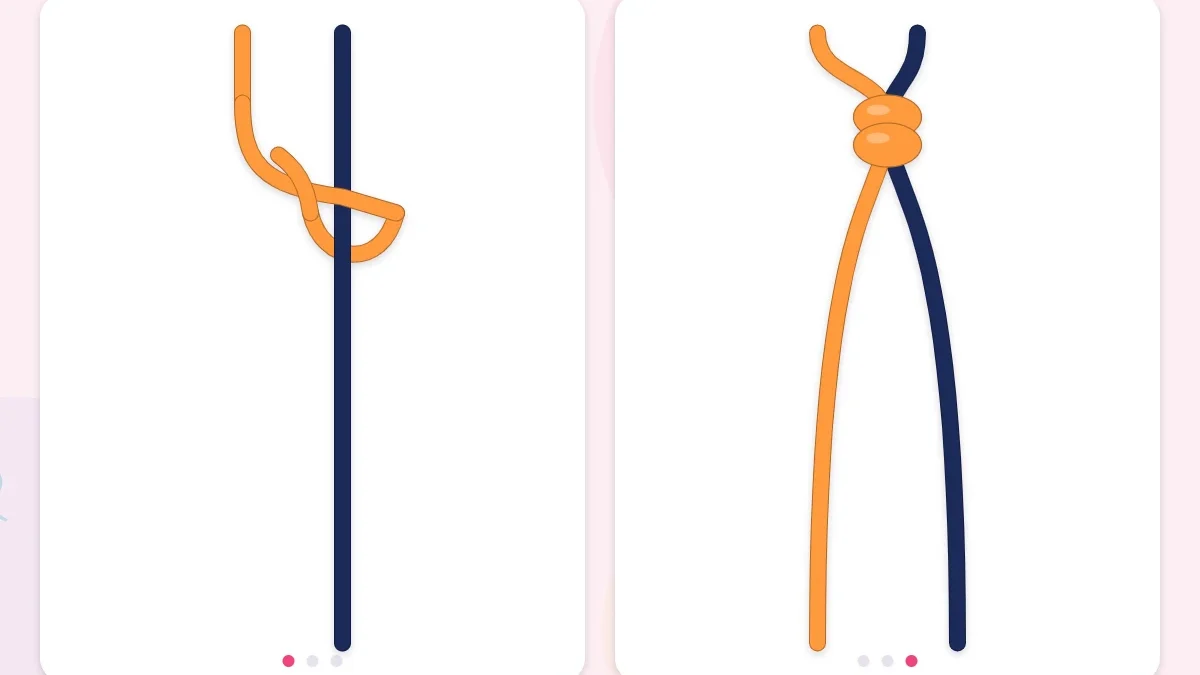
Tutorial at a glance
Materials
- Embroidery floss in 2 contrasting colors
- Scissors
- Tape or a clipboard
Most knots carry a string sideways. The forward-backward knot is for the moments when a string has to show its color and then stay exactly where it is. It is made from two half hitches you already know, one in each direction, and it is the knot behind tidy left edges, turning points and the outlines of shapes.
What Makes the Forward-Backward Knot Different
In a regular forward knot, both half hitches go left to right and the working string finishes on the right of its neighbor. In a forward-backward knot, the first half hitch goes forward and the second goes backward. The working string steps to the right, then steps back, and returns to the left.
Three things follow from that:
- The two strings do not trade places. Whatever order they were in before the knot, they are in the same order after it.
- The knot shows the color of the working string, which here is the string on the left.
- On a chart, the knot is drawn with an arrow that goes to the right and then bends back to the left.
How to Tie a Forward-Backward Knot
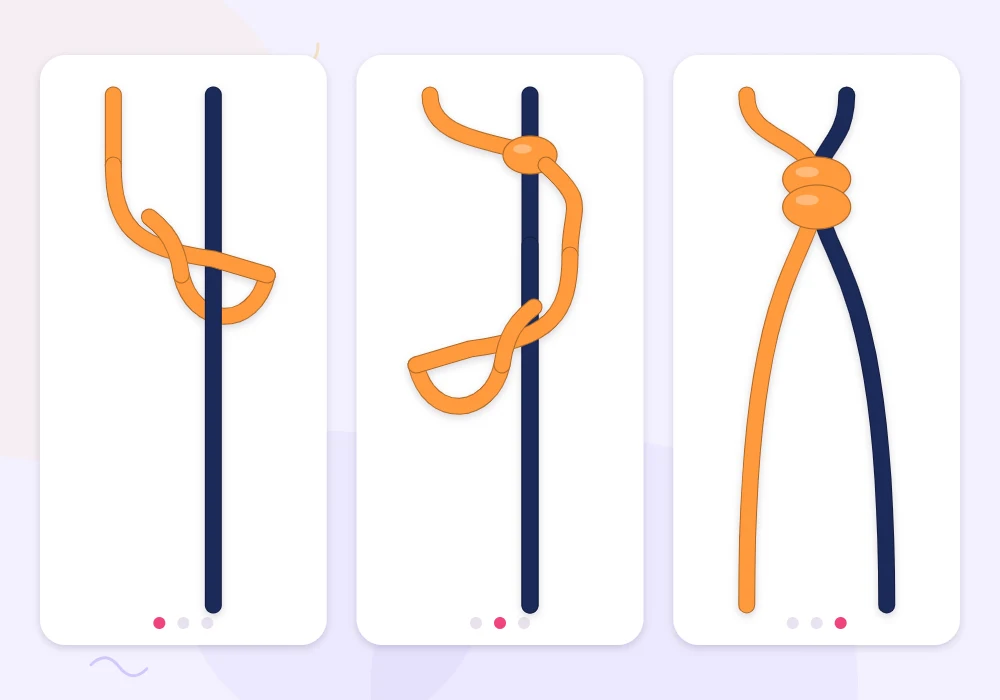
Practice with two strings about 30 in (76 cm) long, knotted at the top and taped down. This guide uses tangerine orange on the left as the working string and navy on the right as the holding string. If the single-direction knot is not yet automatic, spend a few minutes with the forward knot guide first.
- Hold the navy string taut. Pull it straight down and keep it still for the whole knot.
- Tie one forward half hitch. Lay tangerine over navy in a “4” shape, pass it under navy and up through the opening, and pull it up to the top. Tangerine is now sitting to the right of navy.
- Tie one backward half hitch. With the same tangerine string, make a backward “4” over the same navy string, pass it under and up through the opening, and pull it up until it rests against the first half hitch.
- Check. You should see one tangerine bump, with the tangerine string hanging on the left again, where it started.
When a String Must Turn Back
The easiest way to understand this knot is to think one row ahead. Every knot in a pattern does two jobs: it places a dot of color, and it decides where two strings will be for the next row.
- If the left string should show its color and move right, the pattern calls for a forward knot.
- If the left string should show its color and stay on the left, the pattern calls for a forward-backward knot.
So the forward-backward knot is a way of saying “this color, here, but do not go any further.” A diagonal line of forward knots that ends with a forward-backward knot stops moving right at that point. The string is then in position to be picked up by backward knots and head back the other way.
Edges and Shapes That Use It
A clean left edge
In many patterns the outermost string changes all the time as colors travel across, so the edge is striped. When a design wants one border color down the left side, the leftmost string ties a forward-backward knot around its neighbor each time that pair comes up. The border string shows its color and stays on the outside, row after row.
Turning points
Wherever a line of color travels to the right and then reverses, there is usually a forward-backward knot at the corner. This is common in designs built from back-and-forth diagonals, such as some layouts of the zigzag friendship bracelet pattern.
Outlines and points of shapes
Diamonds, arrowheads and hearts all have places where an outline stops and changes direction. On the left-hand side of a shape, that corner is typically a forward-backward knot, because the outline string has to stay inside the shape instead of wandering off across the bracelet.
Vertical lines
Stacking forward-backward knots on the same pair of strings, row after row, makes a straight vertical line of one color. Regular knots cannot do this, since they push the color sideways every time.
Tension: Keeping the Knot Round
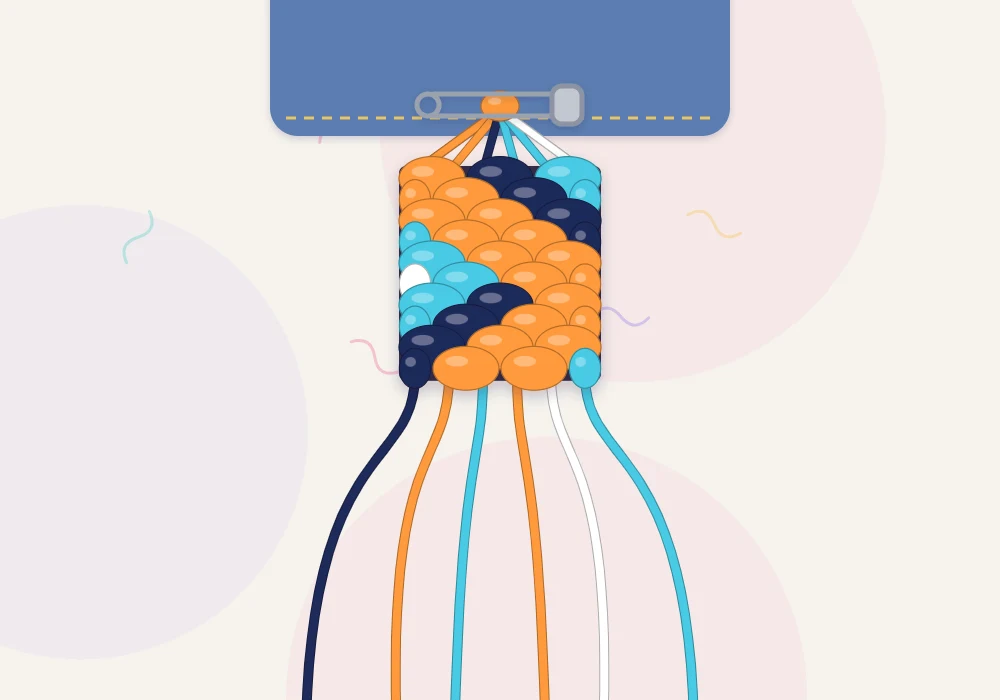
Because its two halves pull in opposite directions, a forward-backward knot behaves a little differently from a one-direction knot.
- Pull each half its own way. Tighten the forward half hitch up and to the right, and the backward half hitch up and to the left.
- Match the pressure. If the second half is pulled harder than the first, the knot tips over to one side and looks flat.
- Keep the holding string taut throughout. Letting go between the two halves is the usual reason this knot comes out loose.
- Compare with its neighbors. A good forward-backward knot is the same size as the forward knots beside it. If it looks wider, ease off on the first half hitch.
Watch out
At an edge, the working string makes a tiny loop as it turns back. If the backward half hitch is left slack, that loop grows and the edge looks bumpy. Slide the second half hitch all the way up before you let go.
Forward-Backward or Backward-Forward?
There are two knots that leave both strings in place, and they differ only in which string does the tying. When two strings meet and neither should move, look at the color the chart wants:
| Color needed | Knot | Working string |
|---|---|---|
| The left string’s color | Forward-backward | Left string, returns to the left |
| The right string’s color | Backward-forward | Right string, returns to the right |
The mirror version has its own guide: the backward-forward knot. Symmetrical patterns nearly always use the two together, one on each side.
Tip
Say the name as you tie: “forward” on the first half hitch, “backward” on the second. It keeps the order straight and reminds you that the knot is not finished until both halves are done.
Spotting It in a Chart
Look for the circle whose arrow heads right and hooks back to the left. The two strings that enter that circle leave it on the same sides they came in on, which is a quick way to confirm you are reading it correctly. If arrows and circles are still new to you, the guide on how to read friendship bracelet patterns explains the whole chart system.
Frequently asked questions
What is a forward-backward knot?
It is one forward half hitch followed by one backward half hitch, tied with the left string around the right string. The working string ends on the left, where it started.
When do you use a forward-backward knot?
Whenever the left string of a pair should show its color but not move to the right, such as on a left edge, at a turning point or on the outline of a shape.
Do the strings switch places in a forward-backward knot?
No. Both strings leave the knot on the same side they entered, which is what separates it from a regular forward knot.
Why does my forward-backward knot look flat or lumpy?
The two halves were probably pulled with different pressure. Tighten the first half up and to the right, the second up and to the left, and match the force.


