How to Fix Friendship Bracelet Mistakes Without Starting Over
Repair a friendship bracelet instead of restarting it. Learn to unpick a knot with a pin and fix wrong colors, gaps, curling, uneven edges and a string that runs short.
Tutorial at a glance
Materials
- Straight pin or blunt tapestry needle
- Scissors
- Spare embroidery floss in matching colors
- Clear craft glue
A wrong knot three rows back is not a reason to cut the strings and begin again. Almost every problem in a knotted bracelet can be repaired in a few minutes, and learning how to fix friendship bracelet mistakes is part of learning the craft. The tools are modest: a straight pin or blunt needle, good light and patience. Start by working out which of the problems below you actually have.
Find the cause first
| What you see | Likely cause | Fix |
|---|---|---|
| A knot in the wrong color | Wrong string used as the working string, or strings out of order | Unpick back to the knot and retie |
| Small holes between knots | Second half hitch not pulled up, or holding string slack | Tighten or retie; hold the other string taut |
| Bracelet twists or curls | All knots leaning one way, or tension too tight | Ease tension; press flat when finished |
| Wavy or stepped edges | Edge knots tighter or looser than the rest | Even out edge tension row by row |
| One string much shorter | It did more knotting, or was cut short | Join a new string on the back |
How to unpick a knot with a pin
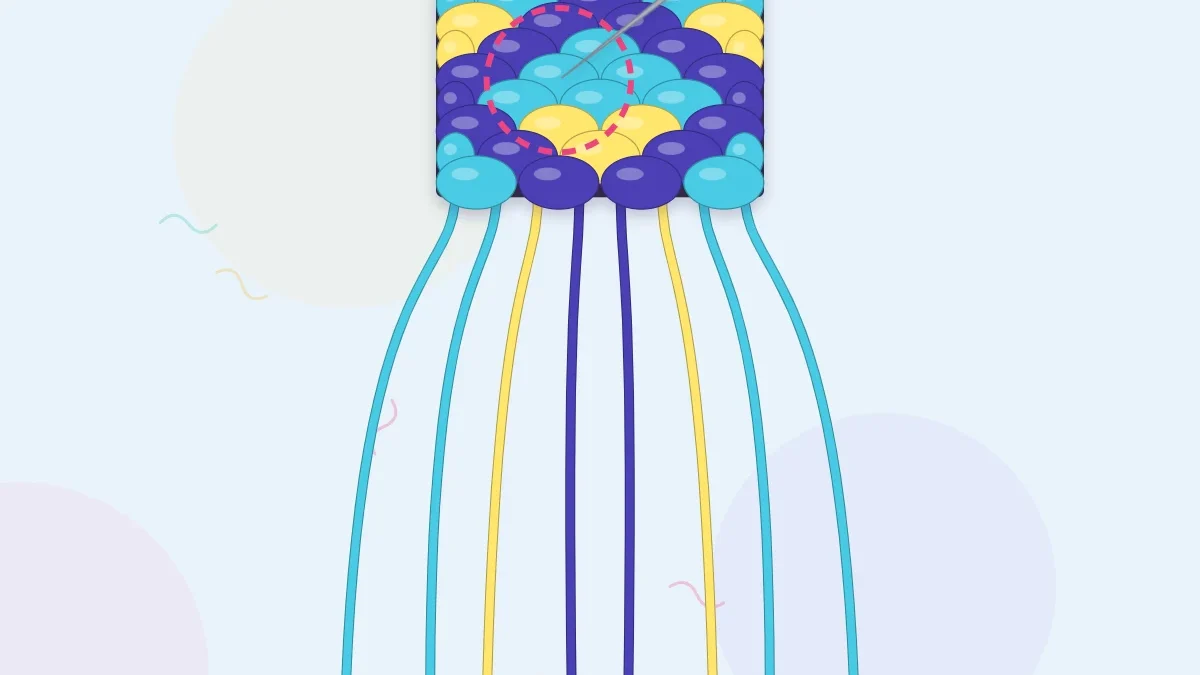
Every knot is two half hitches, and they come out in reverse order: the second one first, then the first.
- Find the most recent knot. Mistakes are always undone from the newest knot backward, one at a time.
- Slide the tip of a pin under the lower loop of the knot, between the working string and the string it wraps around.
- Lift gently until the loop loosens, then pull the working string’s tail back out through it. That removes the second half hitch.
- Repeat on the remaining loop to release the first half hitch.
- Smooth the string between your fingers before retying. A crimped string is normal and straightens under tension.
Watch out
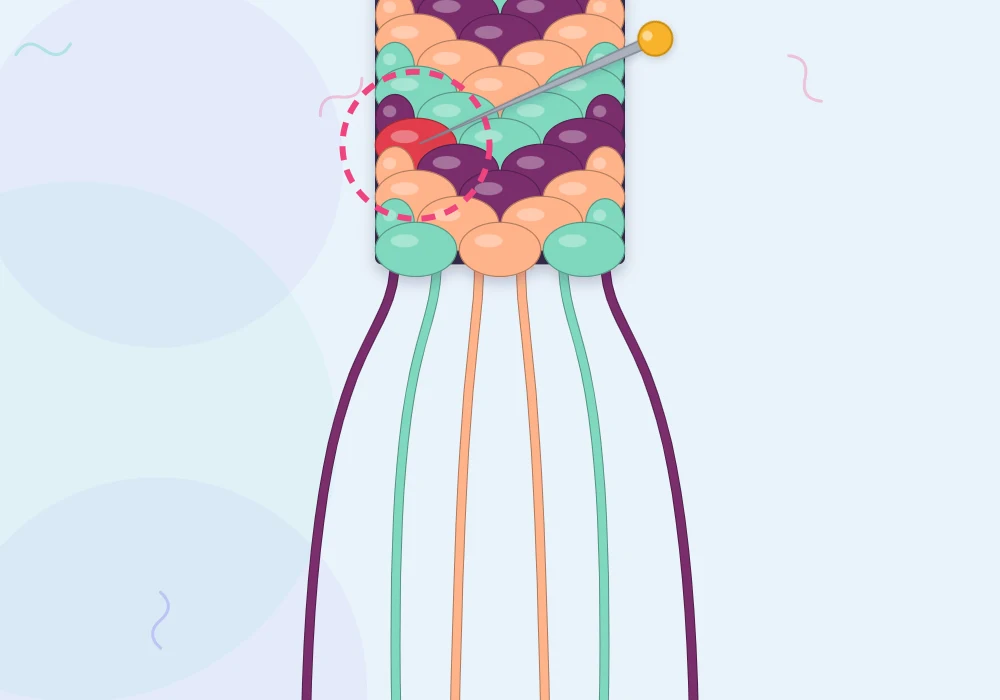
Lift the loop; do not stab the thread. A pin pushed through the middle of the floss splits the six strands and leaves a fuzzy patch that shows in the retied knot. A blunt tapestry needle is gentler than a sharp pin.
Fixing a wrong-color knot
A knot always shows the color of the working string, so a wrong color means the two strings swapped roles. It happens most often with a knot tied in the wrong direction or a row started from the wrong string.
- Caught within the same row: unpick back to the error, check the string order against the pattern, and retie.
- Caught several rows later: unpick row by row. It is slow, but skipping ahead to pull out a buried knot distorts everything around it.
- Caught much later: consider leaving it. One odd knot in a long bracelet is rarely noticed, and you can repeat it at regular intervals to turn it into a deliberate accent.
If the same error keeps returning, the cause is usually in reading the chart, not in your hands. A review of how to read friendship bracelet patterns helps, especially the difference between odd and even rows.
Closing gaps and loose knots
Gaps appear when a knot sits lower than its neighbors. Three habits prevent them:
- Pull each half hitch up to the row above before starting the next one. Two half-tightened hitches never settle as well as two snug ones.
- Keep the holding string straight and taut while the working string wraps around it. If the holding string bends, the knot has nowhere firm to sit.
- Pull upward and slightly toward the previous knot, not straight sideways.
A loose knot in the current row can often be saved without unpicking: hold the neighboring string taut and tug the working string firmly until the knot slides up. If the gap is older, unpick back to it. The step-by-step guide to the forward knot covers tension in more detail.
Curling and twisting
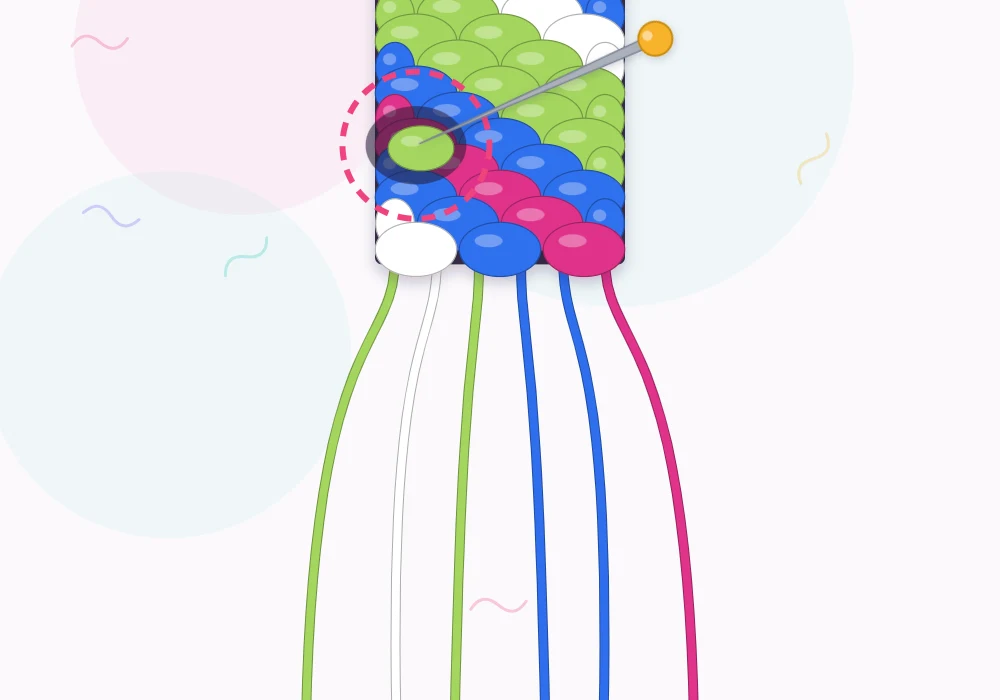
Some curl is built into the structure. In a candy stripe, every knot leans the same way, so the band naturally spirals a little; mirrored patterns such as chevrons balance themselves and lie flatter. Extra-tight knots make any pattern curl more.
- Ease off slightly. Knots should be snug against each other, not strangled.
- Flatten the work every few rows by pressing it between your fingers.
- After finishing, dampen the bracelet lightly, shape it flat, and leave it under a heavy book overnight.
Uneven edges
Edges wander when the first and last knots of a row are pulled differently from the middle ones, or when an edge string is left hanging loose between rows. Before the first knot of each row, pull the edge string down gently so it lies snug against the side of the bracelet, with no loop sticking out. Then tie the edge knot with the same pull as every other knot.
Edges on the right side often look worse because knots tied right to left feel less natural for many people. Practicing the backward knot until it matches your forward knots evens both sides.
When a string runs short
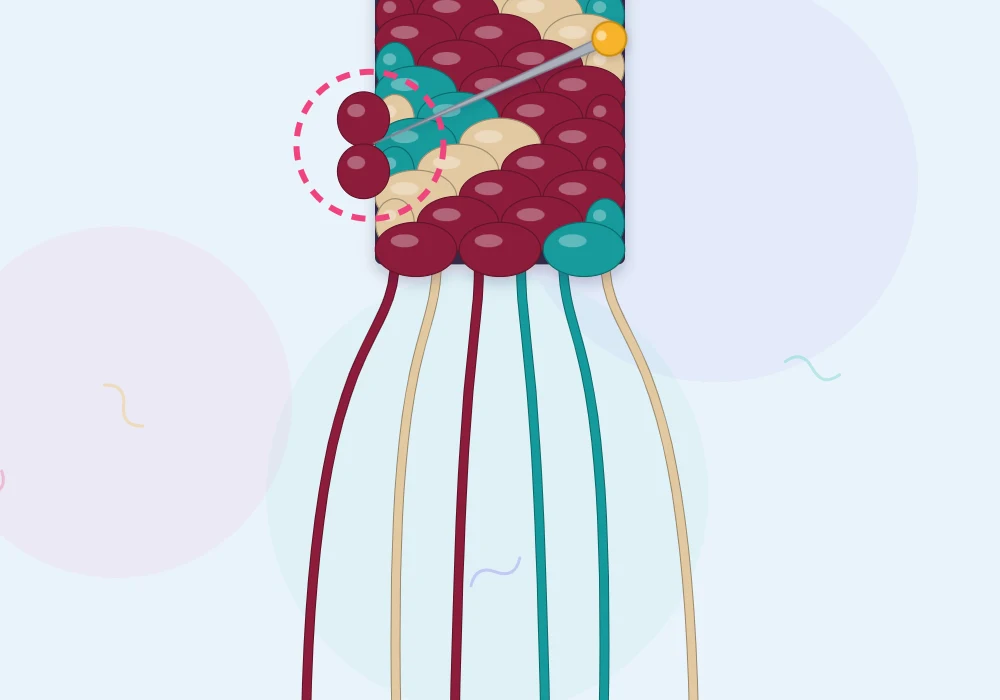
A string that is too short to finish can be replaced mid-bracelet.
- Cut a new string of the same color, long enough to complete the bracelet plus 4 in (10 cm).
- Stop while the short string still has at least 2 in (5 cm) left.
- Lay the new string beside the short one with its top end pointing up the back of the bracelet, leaving a 2 in (5 cm) tail.
- Tie the next knot with the new string in place of the old one, and continue the pattern.
- After a few more rows, tie the old tail and the new tail together on the back with a small, tight knot. Add a tiny drop of clear craft glue, let it dry, and trim.
Tip
If several strings are running short at once, the bracelet was cut too short for the pattern. Finish with longer braided ties instead of joining every string, and check the lengths in how to measure friendship bracelet string before the next one.
Frequently asked questions
How do you undo a knot in a friendship bracelet?
Slide the tip of a pin under the lower loop of the newest knot, lift to loosen it and pull the working string out. Repeat for the second loop, and always undo knots from newest to oldest.
Why is my friendship bracelet curling?
Patterns with all knots leaning one way, such as the candy stripe, spiral naturally, and very tight knots add to it. Ease your tension and press the finished bracelet flat under a book overnight.
What do I do if a string is too short to finish?
Lay a new string of the same color beside it, start knotting with the new one, then tie the two tails together on the back and trim them.
Why are there holes in my bracelet?
A knot was not pulled all the way up to the row above, usually because the second half hitch was left loose or the holding string was slack. Keep the holding string taut and tighten each half hitch fully.


