Ombre Friendship Bracelet: How to Plan a Smooth Gradient
Plan an ombre friendship bracelet that fades smoothly: how to choose and order four shades, avoid hard jumps, and what the gradient looks like in candy stripe, chevron and horizontal bands.
Tutorial at a glance
Materials
- Embroidery floss in 4 shades of one color family
- Scissors
- Tape or a clipboard
- A white surface for comparing shades
An ombre friendship bracelet swaps bold contrast for a slow fade: one color sliding from pale to deep, or one hue melting into the next. The knots are the same ones used in any striped bracelet. What changes is the planning, because a gradient only looks smooth when the shades are chosen and ordered with care. This guide covers picking the floss, lining it up, and how the fade behaves in diagonal stripes, chevrons and horizontal bands.
Choosing shades for a gradient
There are two kinds of ombre, and both work on a bracelet:
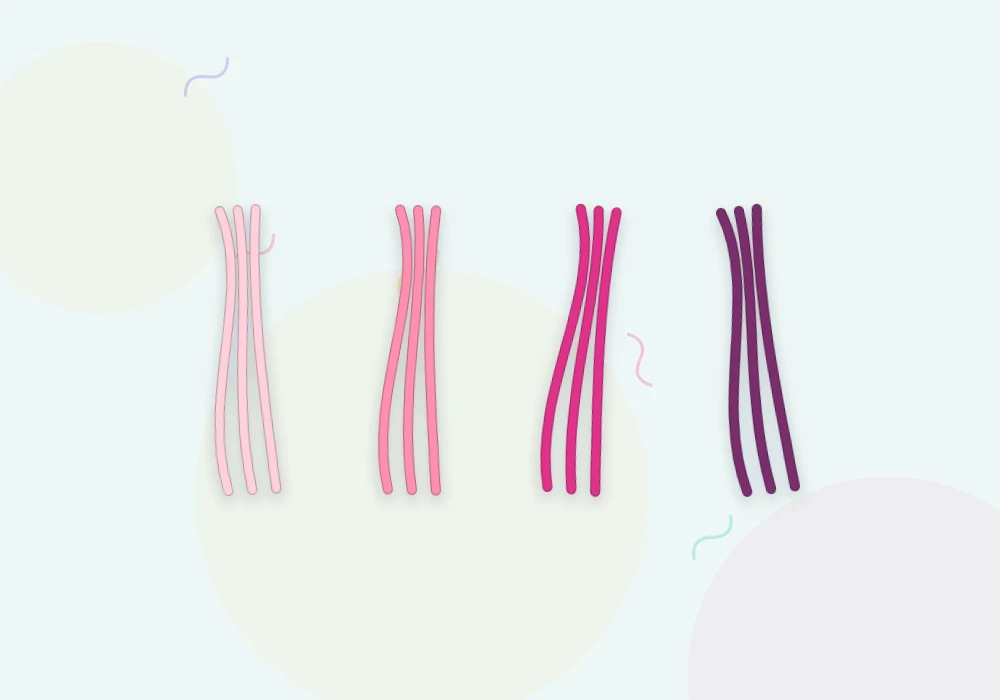
- Single-hue ombre: one color family from light to dark, such as blush, rose, magenta and plum.
- Hue-shift ombre: neighboring colors that blend into each other, such as lemon, tangerine, coral and magenta for a sunset fade, or mint, aqua, teal and navy for a deep-water fade.
Four shades is the sweet spot for a standard bracelet. Three can look like plain stripes, and more than six makes the band wide before the fade has room to repeat. Standard six-strand cotton embroidery floss is the easiest material for this because it is sold in long runs of closely related shades; the guide to the best thread for friendship bracelets compares it with the alternatives.
Checking that the steps are even
The most common ombre problem is an uneven jump: three shades that sit close together and a fourth that leaps ahead. Check before you cut:
- Lay the skeins side by side on a white surface, lightest on the left.
- Squint, or take a photo and view it in black and white. Each skein should look one clear step darker than the one before.
- If two skeins look identical in the photo, remove one. If there is a big gap, look for a shade that sits in between.
Tip
Judge shades in daylight. Warm indoor bulbs pull pinks, peaches and yellows toward each other, and a gradient that looks even at night can show a visible jump the next morning.
Why string order matters
In every knotted stripe pattern, the colors appear along the bracelet in the same order the strings are taped down, and then the sequence starts again. With strings ordered light to dark, the fade runs smoothly through the shades and then snaps from the darkest straight back to the lightest. That hard line is not a mistake, but you should decide whether you want it. You have two choices:
| String order | What you see | Feel |
|---|---|---|
| Light to dark (1 2 3 4) | A fade, then a sharp jump back to light | Graphic, like repeated shaded blocks |
| There and back (1 2 3 4 3 2) | Light to dark to light in a continuous wave | Soft, no hard line anywhere |
The there-and-back order uses two strings of each middle shade and one each of the lightest and darkest, so the two end shades appear as thinner stripes.
Ombre in a candy stripe
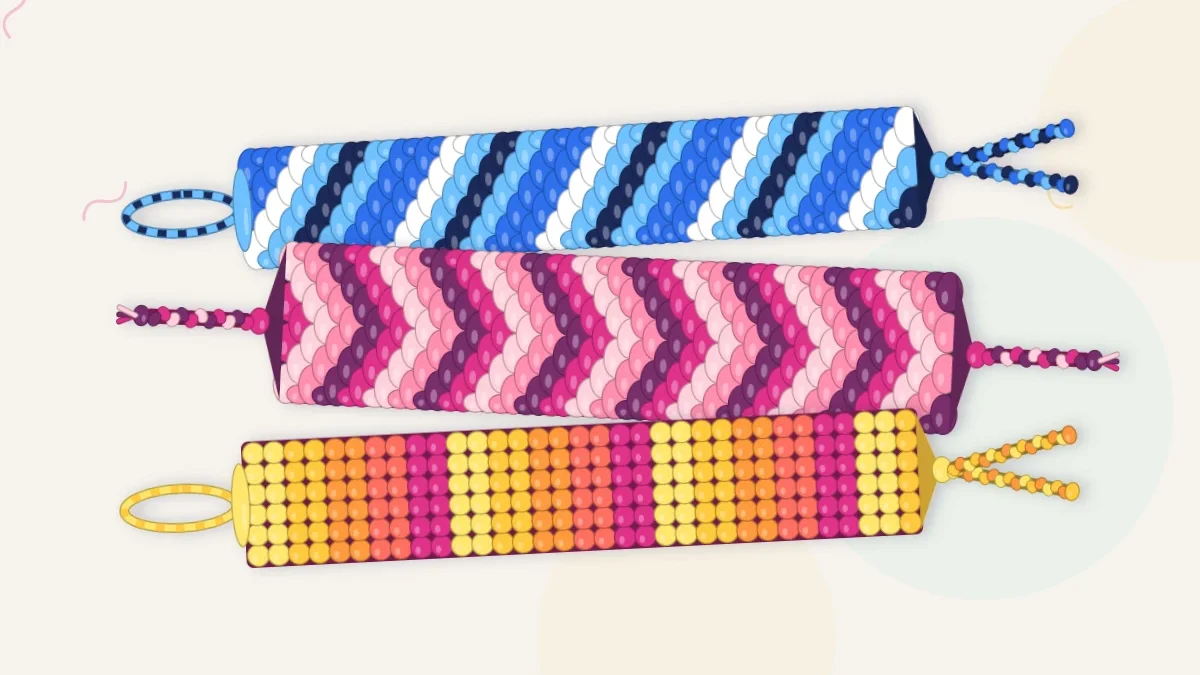
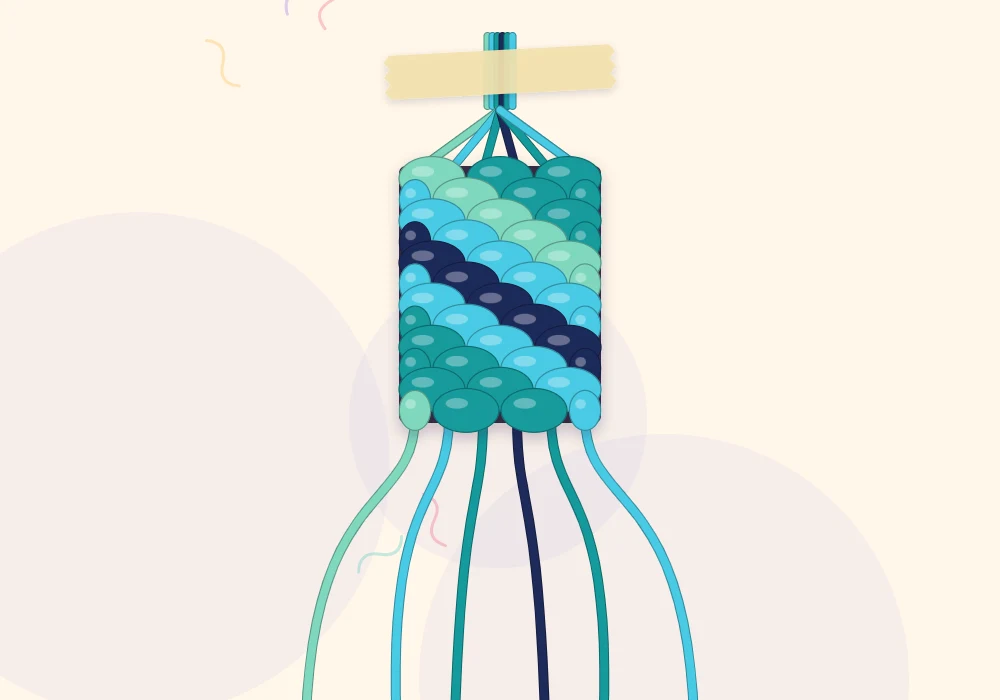
Diagonal stripes are the simplest home for a gradient. Tape down six strings in the order mint, aqua, teal, navy, teal, aqua, then knot as for any candy stripe bracelet: the leftmost string ties forward knots across every other string, row after row. Because each row moves the next shade to the front, the bracelet darkens and lightens in a steady slanted wave.
Cut each string about 32 in (81 cm) long. All strings do the same amount of work in this pattern, so they are used up at the same rate.
Ombre in a chevron
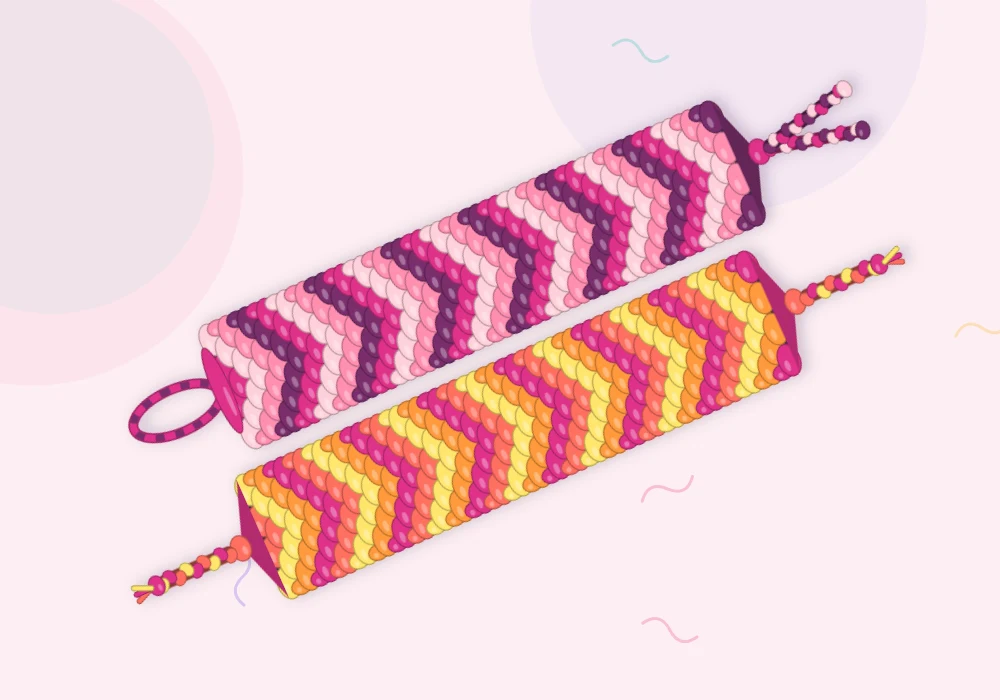
A chevron mirrors its strings, so the fade becomes a stack of V shapes. For a four-shade gradient, cut two strings of each shade and arrange them light to dark to the center and dark to light back out: 1 2 3 4 4 3 2 1. The outer pair is knotted first, so the lightest V appears at the top, followed by each darker shade, and then the sequence restarts. The result looks like shaded arrowheads pointing down the wrist. The full method is in the chevron bracelet tutorial.
For a chevron with no hard line, use three shades in the half order 1 2 3 2, which gives eight strings: 1 2 3 2 2 3 2 1. The Vs then run light, middle, dark, middle and repeat without a jump.
One long fade with horizontal stripes
Diagonal and chevron patterns always repeat the gradient several times along the wrist. If you want a single fade from one end of the bracelet to the other, use horizontal bands instead. In a striped friendship bracelet one working string knots across the whole row, so you control exactly how many rows each shade gets. Knot five or six rows of the lightest shade, the same of the next, and so on to the darkest.
For a softer blend between bands, alternate single rows of the two neighboring shades for three or four rows where they meet. The thin alternating lines read as an in-between tone from a distance.
Watch out
In a horizontal-stripe bracelet the working string is used up far faster than the strings it knots over. Cut each shade much longer than a normal bracelet string, and do not start a band with a nearly finished length.
Common ombre problems
- The fade looks like plain stripes. The shades are too far apart. Add an in-between shade or drop the palest one.
- Two stripes look like one wide stripe. The shades are too close. This can be attractive, but if it was not intended, replace one of them.
- One shade seems out of place. It probably leans warmer or cooler than the rest, for example a peachy pink among bluish pinks. Compare skeins in daylight and swap it.
- The order got mixed up while knotting. Strings of similar shades are easy to confuse. After each row, fan the strings out and check that they still run in sequence before continuing.
Frequently asked questions
How many shades do I need for an ombre bracelet?
Four shades give a clear fade on a standard bracelet. Three can work if the steps are even, and five or six suit wider patterns.
Why does my ombre bracelet have a hard line in it?
The colors repeat in string order, so after the darkest shade the pattern returns to the lightest. Arrange the strings light to dark and back again if you want a continuous wave instead.
Can I make an ombre bracelet with different colors instead of shades of one color?
Yes. Choose neighboring hues that blend into each other, such as yellow, orange, coral and pink, and check that each one is a similar step from the last.
Which pattern is best for a first ombre bracelet?
Candy stripe is the easiest because it uses only the forward knot and shows every shade as a clean diagonal line.